
Why learn Classical Greek?
My journey as a Hellenist.

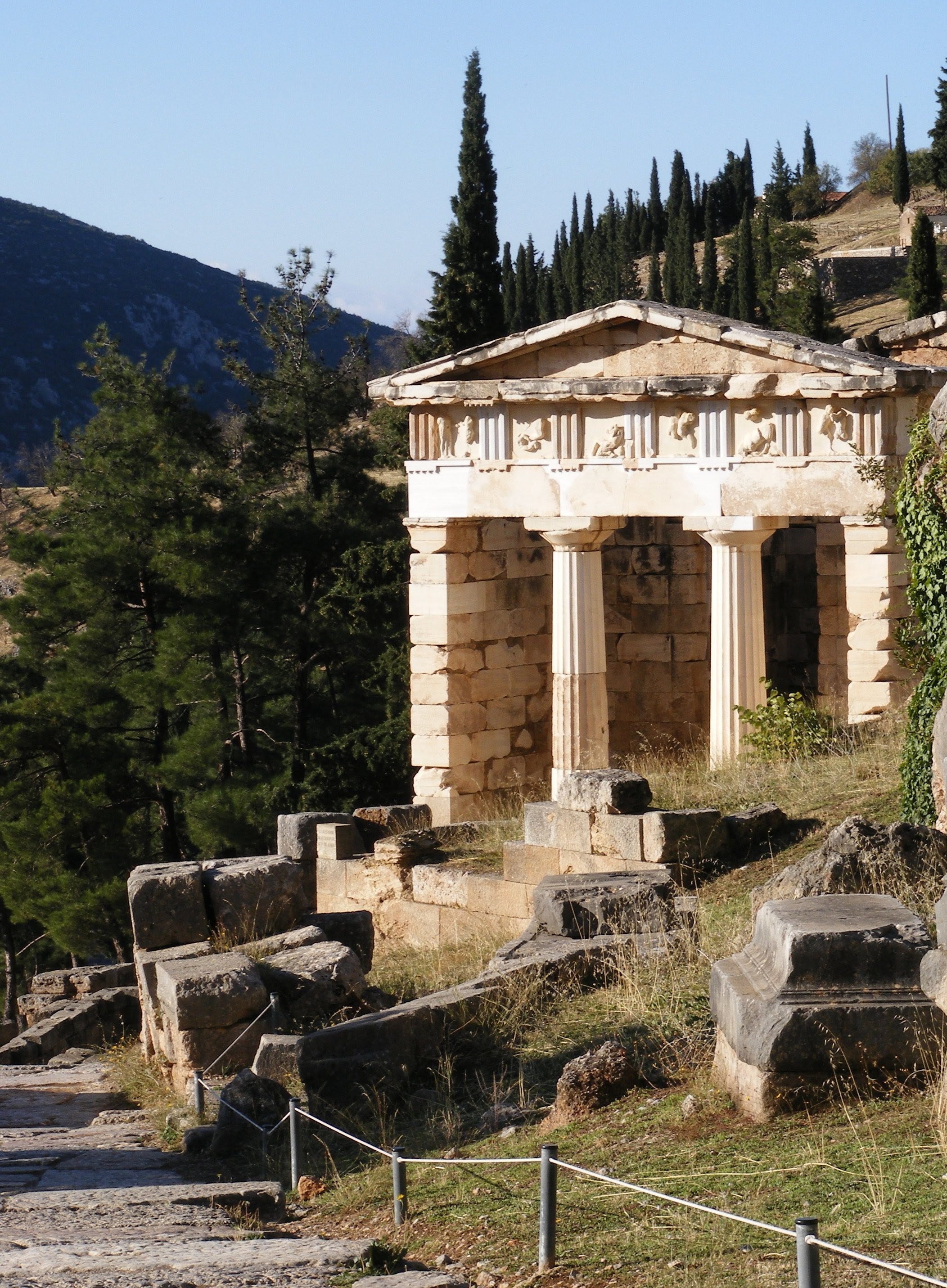
(Athenian Treasury at Delphi, 2009, own photo)
I knew from my first Latin lessons that I wanted to study Classics. My grammar school didn’t offer Classical Greek or Classical Civilisation, so I tinkered around the edges of these subjects on my own, learning the alphabet from a book I found on holiday and reading everything I could on classical myth and ancient history. I applied to study Classics at university without knowing very much about classical Greek. Still, I assumed that my love of the Latin language would help me to become a keen Hellenist too.
As part of my university offer, I had to attend a Classical Greek summer school to get me up to GCSE standard by the start of Freshers’ Week in September. I chose the JACT Greek Summer School at Bryanston in Dorset and spent two weeks of thrice-daily lessons and homework from Dr Anthony Bowen, with evening lectures, orchestra practices, and two Greek plays (Aristophanes’ Wasps and Euripides’ Hippolytus). It was an intense experience, but I came away loving Greek and having made friends with whom I’d go through three years of undergraduate study; we met up recently and reminisced about those Intensive Greek language lessons with the wonderful Dr Rosanna Omitowoju and getting thrown into Lysias 1 with only three weeks of Greek under our belts. Life as a Classics student revolved around language lessons, lots of unseen translation, and studying the set texts, which ranged from the big hitters of Homer’s Odyssey to the more niche Ion by Plato. I still have my annotated texts - with lots of vocabulary written over the top (having to build an extensive knowledge base of Greek language in a year was definitely a challenge!) For my third year, I chose to focus on Plato for half of my finals; a Plato paper taught by Nick Denyer and my dissertation on the arts in Plato’s Republic X.
I’ve been lucky enough to keep developing my love of classical Greek throughout my teaching career, teaching A Level Greek language and Sophocles’ Electra in my NQT year, and also having the privilege of starting many young Hellenists off on their Greek journey. I’ve been teaching a Year Ten class this term - we’ve focused on establishing a strong foundation of the language, playing definite article jigsaw as well as many, many card games. We’ve also had a ‘culture break’ in our double lesson, looking at aspects of Greek myth and culture, from Euripides’ Bacchae to the Amazons and the goddess Nike.
I’ve been reflecting on the benefits of having a knowledge and understanding of classical Greek. A vet friend recently mentioned ‘brachycephalic’ dogs - ‘βραχυς’ (brakhús) is the Greek for ‘short’, while ‘κεφαλη’ (kephale) means ‘head’, so I was able to understand that she was speaking of dogs such as pugs, which have short heads and flattened faces. I’d say that Greek helps with many third-tier words like these - I often find I can work out a University Challenge Science question using my Greek knowledge.
I’ve drawn up the following poster, which I’ll use with my younger classes when we introduce classical Greek to them to help them understand why we’re teaching another ‘dead’ language. For me, the prime joy of Greek is reading Plato, Euripides and Aristophanes in the original language, bringing to them also an understanding of the immense cultural impact of classical Athens, which introduced Europe to democracy, theatre and philosophy.
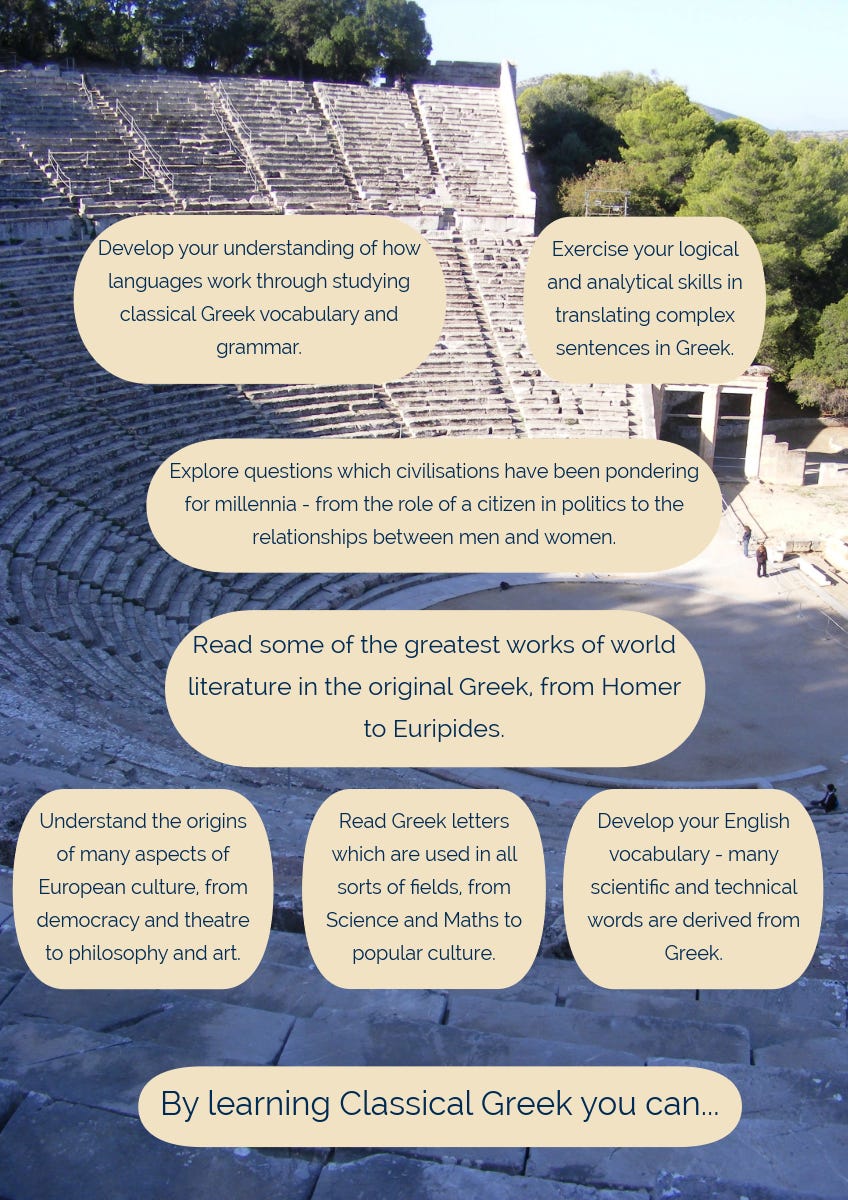
The photo behind the text is Epidaurus in Greece - a theatre with the most incredible acoustics. I took the image on a school trip to Greece - being a Classicist does come with the perk of some fantastic Mediterranean travel opportunities.